Showing posts with label Natural Life. Show all posts

17 October 2014

This Permaculture Thing

A couple of weeks ago now we took a little drive to a spot about an hour from home to check out the permaculture garden at Melliodora, created by David Holmgren and his partner over the past 30-odd years. David Holmgren is one of the originators of the concept of permaculture. To be honest, I really didn't know what to expect, apart from the simple joy of having a poke around someone else's garden. 

Giant old pear tree.
A tree branch conveniently blocking our host's face.
A husband and a son.
What I didn't expect was to be so taken with what permaculture is, and what it isn't. I thought it was just  a way of gardening, really. But it is not just a way of gardening. And then on closer inspection, you could conclude that it is a type of counter-culture movement, but it is not a counter-culture movement. It is so much more than that. I don't even know really how to describe it. 

source
I think this 'permaculture flower' thing sums it up quite well. For me, it pulled together so many elements of our way of life, our beliefs, and what we plan for the future, all into one place. And there it is - all bundled up very neatly into this thing called permaculture. I'm fully immersed in reading a fascinating book on the subject (this one) right now, and it's refreshing, challenging and downright reassuring. 

We've definitely got some new ideas on how this garden will take shape here in our little corner of the world. Slow and steady is how we plan to go about it all. Already it's drying off so much and we've not even hit summer yet. A lot of our plans will have to wait until next year, or even later, but I guess that gives us time to make sure they are really good plans.

For more informative blog posts than mine about the Melliodora property, here are some good links:
Permaculture Parr
PermaCultured
and this interesting piece on Simple Lives.

22 June 2014

Wintery musings


I am loving these days of winter. We are keeping warm, rugging up, indulging in warm coats and beanies. I think I am starting to come to terms with winter in Central Victoria. Grey, heavy skies are the norm, sometimes with rain, sometimes not. Quite different to the Canberra winter I grew accustomed to for most of my life. I don't miss the super cold nights of a Canberra winter, but the brilliantly sunny days do more than make up for a chilly night. Still. There is something so beautiful about the heavy skies here, and wearing bright, cheerful, colourful clothes helps. Adding warmth and colour to a grey background. Ask me in late August, I may not be loving the grey skies quite so much. But right now I am.

I have been eating meat. I have been a vegetarian for some years now, and prior to actually making the vegetarian decision, I rarely ate meat anyway. When I was pregnant I started eating some fish again, and have kept that up. But this winter, I have had to start back on some meat. My body needs the nourishment. My reserves have been drained, with pregnancy, having a baby and sustained breastfeeding. I was feeling flat, cold, tired, with a fog in my body and my brain. So I heeded some sound advice (despite having ignored similar advice received earlier) and carefully, mindfully, I have added some meat to my diet. Making chicken stock with organic bones. Slow oven-cooked lamb chops, in tomatoes and red wine. Making sure I get meat with bones, and cooking slowly and gently, to draw out the most nourishment. My body is responding well, and where I thought I would have trouble with eating it, I have not. And the fog in my brain is lifting; I feel more like an earlier version of 'me' that I thought had gone.

Our afternoons always have a walk, a bundled-up-against-the-cold kind of walk. We take the pram, and William sits under a blanket. He holds the dog leads, or munches on an apple, and we head down to the local park. We walk near the lake and feed the ducks, or watch the kids at footy practice, or take a ball and bounce it around. Always William hops out to do some walking of his own, taking the dogs on their leads (he is getting so good at hanging on to them!), choosing the direction and setting off with purpose. Toddlerhood is an amazing thing to watch. It has it's frustrating moments, I am the first to admit that. But the balancing factor is the pure joy and amazement, watching this little person interact with his world. Seeing him engage, making things happen as he thinks they should, being his own independent little person. Exhausting and exhilarating, all in one.

And in the garden, there is an abundance of green. Broccoli heads grow large, weeds shoot up in an instant (or so it seems), broad beans tower over the rainbow chard, and the celery just grows and grows and grows. Bare leaves of the plum tree against these grey skies, reveal birds hopping around on the branches; in summer, we can only hear them but in the stillness of winter, we can see them too. Bulbs have been planted, and we wait and wonder if we will get to see them bloom. House moves are on the cards; our decision to move on from here has a domino effect and we make our house available for others to view, potentially as their new home. My work in the garden now, is just out of love for the process, and hoping that someone else will enjoy seeing flowers come to life in springtime. But I also plant in pots, to make sure I have something to take with me. And a cutting of the beautiful climbing rose, I will definitely take a cutting or three. 

How is winter looking in your neck of the woods? Or summer, if you're in the Northern parts?

23 December 2013

Baby-Led Weaning: Tips, Tricks and Ideas


I wrote in this post a little while ago about how we decided to use baby-led weaning to start out little one on solids. I am so happy with that decision. Our meal times are so much fun! Watching William carefully pick out foods to put in his mouth, skilfully spit out skins that he doesn't want and carelessly remove from his table [throw on the floor] any foods he doesn't want. We're watching his personality unfold at the kitchen table, that is for sure. Anyway, I have learned a thing or two along the way - little things that make my life easier, ensure more food ends up in his mouth instead of on the floor, and [possibly] reducing the mess to be cleaned up after each meal. It's definitely a messy business, no doubt about it. All worth it though. Here's a couple of things I've learned.

Sticky rice.
I cannot emphasise enough how good sticky rice is. Think risotto, think brown rice that is cooked much longer than usual with more liquid added, and rice porridge with milk for breakfast. Once the cooking is finished, you can add a little more liquid and let it stand for a few minutes, to thicken it up some more. Sticky rice sticks to a spoon! So baby can turn the spoon upside down, inside out, this way and that, and usually, still have rice stuck to the spoon by the time it makes it to their mouth. Rice that doesn't stick to the spoon is much messier to clean up. Which brings me to my next tip...

Use cutlery.
Our baby was using a spoon from the word go with solids. He knew enough from having watched us eat to know roughly what to do with it. The very first time he used a spoon, he poked it in his mouth a bit too far. That was the one and only time he's done that. Now he happily waves it around and will eat from it if he wants to, or throw it on the floor if that's what he feels like doing. After a couple of months I started letting him use a fork as well [the little baby spoons and forks only]. We watch him closely with it, and remove it from his hands if it doesn't have food on it, but he has learned how to eat food from a fork remarkably well. We just load up the spoon or fork and hand it to him, and he feeds himself.

Roast vegetables.
Roasting vegies has provided a very easy way for William to feed himself, particularly in the early days when his coordination was still developing. Roasting generally gives a tougher outside 'skin' and a soft cooked inside, great for baby eating. Think roast sweet potato fingers, oven cooked potato chips, roast pumpkin, roast fingers of zucchini. If the outside gets too tough from oven roasting, I just break it open a bit, and he will suck all the good bits out and discard the skins. The skin gives a nice solid base that baby can hang on to while sucking out the softer food inside.

Cooked apples.
Cooked apples are good for baby's digestion, particularly when solids are first introduced. Plus, they're easy for a baby to handle when cut into slices. In the early days, William used to suck on them and didn't actually eat much apple; now he happily eats plenty [if he wants to]. The skin again gives a good structure that is easy for baby to hold on to while the flesh is easily eaten. Simply slice up apple quarters and cook in water until soft, usually 5-10 minutes or so. Sometimes I add raisins or chopped up prunes to the cooking water, to soften them up and for something different; these are also excellent for helping digestion along.  

Make the clean-up easy.
I think one of the biggest reasons people sometimes avoid baby-led weaning is the mess and the necessary cleaning up. I won't lie, it is messy and the cleaning up gets pretty repetitive. So I make it as easy as I can. A wash of baby with a face washer, and a wipe of the high chair with the same washer. We have a plastic mat under the high chair where most of the food lands. I collect all pieces of food from the floor into the chook bucket [those girls do very well out of baby-led weaning] and give the floor a wipe. I have a stash of dedicated floor-cleaning rags for this job which I keep close at hand and which can be washed and re-used. I also use a citrus-infused vinegar cleaner in the clean up.

Relax.
Sometimes I catch myself during meal times and realise how tense I am through my entire body, waiting to catch a spoon that's been turfed or trying to prevent the spoon from being dropped or catch the last piece of broccoli before it hits the floor. Or make sure he's eaten enough, and not just playing and throwing food around. And then I have to remember to breathe. William is happiest and eats best when he's left to get on with it without too much interference. It can be hard to relax and trust the process, but then I stop and remind myself that it's all fun and experience at this stage. And the chooks will always eat what he doesn't. And it's only a mess, it can be cleaned up. And just allow him to do his thing. It's not always easy but I think it's worth it.

That's just a summary of some of the things I've learned to make this whole baby-led weaning thing easier. It is a very rewarding thing to do, I love watching him eating up by himself and improving his coordination and motor skills at the same time. Plus the inclusiveness aspect, whereby he eats what we eat, and we all sit at the table together. So lovely.

Oh, and one more tip. When you have a delicious morsel on your plate and you want to give it to baby [because you love your baby and you want the best for them, obviously], don't. Eat it instead. There's nothing like seeing that yummy delicious piece that you have forgone yourself, get turfed off the tray and onto the floor, without so much as a look at it. Best just eat it yourself.

Oh, and of course, use common sense and trust your judgement. I'm no expert, just a mum for whom these methods are working.

19 November 2013

A Book Launch: Less Toxic Living

I'm very happy to be sharing with you the launch today of a book, Less Toxic Living, by Kirsten McCulloch. Kirsten is the person behind Sustainable Suburbia, a great resource for living more sustainably in the midst of our modern lifestyles. The book Less Toxic Living is a wonderful, comprehensive collection of articles about how we can reduce the toxic burden in our lives. I have to warn you, reading this book will make you change your behaviour, and you may [if you're anything like me] suddenly stop using a lot of products in your home!


Topics covered in the book include toxins in the home, making and using green cleaners, food and water, plastics and cosmetics and skincare. The book is written such that you can open it at any section and read, you don't have to follow from start to finish. All the information is easy to understand, and the best part is that is offers solutions to the everyday toxic things life presents us with. I know for me, I've been aware of many issues identified in this book, but it's all been in the 'too hard to deal with' basket, so I've not done anything. Well, now I have.

Since reading this book, we have added a bunch of indoor plants, switched away from using plastic wherever possible, switched to a safer dishwashing liquid, stopped using commercial liquid hand soap and made a much greater effort to avoid wearing our outdoor shoes inside the house. And a whole bunch more. You'll need to read it to know why we've made these changes! I honestly thought we were pretty on top of living a simpler, cleaner life [I make our soap, and our laundry liquid, isn't that enough?] but I have had my eyes opened a little further through this book. And it offers solutions, not just problems. 

From now until 3 December, you can access the ebook for free. How good is that? Simply follow this link and use the code DUSTYROAD to download a copy. Alternatively, you can find the book on Amazon here, and a paperback version will shortly be available in Australia here. There are also a bunch of freebies if you download the ebook, including printables, a special offer on candles, free book chapters and bonus recipes. I hope you take a look at the book! Also take a look at Sustainable Suburbia if you haven't been over there yet.

8 November 2013

Talking About: Baby Led Weaning

I thought I'd share with you some of my thought about this baby led weaning caper. Our baby is now 7.5 months old and we've been eating solids by baby led weaning for about 6 weeks now. I honestly can't imagine feeding him solids any other way. Before we even started on solids proper, we were eating soup for dinner one evening and I offered him some on his little baby spoon, which he grabbed and tried to feed himself with. So I guess that's where it started. 
Because... what could possibly go wrong?

If you're not sure what baby led weaning is all about, google it, but essentially it involves the baby feeding itself from the start, and eating [I use that term lightly] whatever the rest of the family is eating [within reason and common sense]. This means, no 'baby food' in the traditional sense of jars of mush, no homemade combinations of mush, in fact no separate baby meals prepared. I think it can be a little daunting for some, and many people have concerns that the baby will choke on something.

But it seems little babies, once they lose the reflex to push food out of their mouths, are quite capable of mouthing food around, breaking it up with saliva and their gums, and if a large piece does go in the mouth, they seem quite capable of bringing it back up/out again. Obviously you wouldn't ever leave a baby unattended while feeding and I know I watch our little one like a hawk [discreetly mind you, the idea is not to stare at them but to let them get on with eating!].

It is a wonderful thing to see. We have watched our little baby's hand to mouth coordination develop quickly, and his excitement and enthusiasm for meal time is just so lovely. Watching his face when his bowl turns up, seeing him check over everything, touching and rummaging around to see what looks good to eat, and seeing him discard unwanted things over the side of the high chair [yeah, not my favourite part]. Seeing him pick up a piece of food, bring it to his mouth and pop it in. So sweet.

Over the past 6 weeks he has started to eat much more, as he gets better at holding the food in his hands, getting it into his mouth, and chewing it up. I will say though, more food still ends up on the floor than gets into his mouth. I guess something I often think is that we're lucky we can spare the 'wastage' of some food not being eaten [although in this house, there is no wastage as it all goes out to the chooks, so I don't really mind]. But I can envisage that this may be a problem in different circumstances.

Recently we stopped into a cafe after a wander into town and ordered ourselves some hot chips and drinks. Only when our food started to turn up did we realise 'oops!' as we didn't get anything for William, and he's certainly not going to start eating hot chips at 7 months old [unless I make them for him, and I do]. So I went back to the counter to see what I could find, and ended up ordering him a small bowl of fruit salad. It came, and he sat on his Daddy's knee, in the cafe, eating up his fruit salad. A little girl at a table nearby was heard to exclaim 'look, the baby's eating the fruit salad!'. 

I know this baby led weaning thing is not quite mainstream, but I would not do anything else. I would be depriving our baby of the opportunity to explore and learn about food, to choose what he puts into his mouth, to learn about the different textures, and flavours, and colours, and every other sensory aspect of eating. He knows how to eat from a spoon, he's learning that a fork is different [and sharp]. And seeing what he enjoys eating is just so interesting.

I guess in all this, I believe my role here as the mother, is to guide, show, encourage, support. I occasionally get to spoon feed him, when he lets me. I love that our mealtimes are so inclusive, and that what we eat, is mostly what he eats. I am also of the belief that 'food before one is just for fun', as he is still primarily sustained by my breast milk. Motherhood - another instalment of my take on it. 

Have you tried baby led weaning? Or did you use conventional baby feeding to go onto solids? If you have any questions about how this works for us, by all means ask in the comments section and I'll do my best to tell you all I know. I'll also be posting up some baby led weaning meal ideas in the next few weeks if you're interested to know exactly what we eat.

Please bear in mind that this is simply the story of one family - I do not profess to know all the ins and outs of baby feeding or baby led weaning. As always, do your own research and above all, trust your instincts.

17 October 2013

Homemade: Nappy Balm

For the past couple of months I've been making my own nappy balm for our baby. When William was first born I had no idea that you could make your own - I was just another consumer doing what consumers do, and buying the best we could find. I didn't like it, but it's just what you do, right? Anyway it wasn't long until I realised that you could make your own perfectly well, then another month or so of the idea floating around in my head until it actually happened. And you know what? It is so, so easy, I can't believe I put it off as long as I did. It takes about 10 minutes. It is that easy.

There are lots of recipes for homemade nappy balm out there, this is just a simple one that has been working well for us. If you make it another way or with other ingredients, please do share, as I'd love to know. Whilst I am happy with this balm, I am always on the lookout for ways to tweak and perfect our homemade products.

Ingredients:
1/4 cup coconut oil
2 tsp beeswax
2 tsp almond oil
5 drops lavender essential oil
5 drops tea tree essential oil
storage container

Method:
Over low heat, mix together the coconut oil and beeswax in a small saucepan. Add the almond oil and blend. Remove from heat, add the essential oils and stir well. Pour into your container. Allow it to cool before using it [it will solidify somewhat].

Done! How easy is that? Now there's a couple of things about this recipe. I vary ever so slightly the quantities of coconut oil [a touch less usually], beeswax and almond oil [a touch more usually] based what I want the consistency to be. Coconut oil is solid at room temperature, and liquifies as it gets warm, so in warmer weather I would use slightly more coconut oil and slightly less almond oil. And vice versa in cooler temperatures. The original recipe I used didn't have almond oil but I found the balm became too solid, so I added the almond oil just to keep it a bit softer.

This makes up enough to keep us going for about 8 days. I'm pretty happy with how this balm works on William's skin. When some nappy rash does flare up, I tend to rub the balm in a bit more, the coconut oil seems to help heal and sooth. And it is fine to use with cloth nappies.

So tell me, what else would you/do you add? Or have you never tried making your own? 

27 September 2013

The Homemade Revolution

I was chatting to my mum yesterday, about how many things we're now making from scratch, at home. And I'm not just talking about meals, but they are definitely very homemade from scratch. There's so many other things we've branched out to this year. It's something we've been thinking about, talking about, planning on doing, for ages. Wanting a different way of life, a simpler way, a way that doesn't involve constantly buying 'stuff' and using harsh chemicals. Being more self reliant. I really feel that this year marks a turning point for us, in actually making the changes we need to make for this way of life that we seek. I'm so enjoying this journey too, and I'm excited about making even more things from home. This is what we've been up to so far.

Homemade dog food. A big one! We have two little dogs, who are fussy little eaters. We used to buy them tins of food at the supermarket, which they would sometimes eat and sometimes turn their noses up at. I've always had my doubts about what actually goes into those dog food tins. Plus they add up in dollar terms. Earlier this year I stumbled across a recipe for home-made dog food on Rhonda's blog Down to Earth [see here]. So we tried it, and what do you know - success. We make up a large batch of food, freeze it in portions [we have dedicated dog-food containers now] and use it as we need. Our little dogs have a nice layer of plumpness [is that a word?] on them which I'm happy about over winter. And Mr Ralph has stopped his incessant nibbling at his back [itchy skin] - it just stopped happening. It saves us a huge amount of money, plus the unnecessary use of aluminium tins in preprepared food. We're very happy with how it's working out. 

Homemade soap. I blogged about it here. The only thing I can say about this one is, the end result is well worth the hour or so in the kitchen playing mad scientist to make it. I love using it on my skin. It feels luxurious, it isn't drying, it's creamy and soft and one batch makes a heap of soap. Plus I can flex my creativity in future batches with different scents and added ingredients, like herbs, essential oils, natural colourings and adding exfoliating ingredients. Skincare is a huge area where we are exposed to so many chemicals without really thinking about it [well I never really thought about it anyway] but once you start to pay attention, well, it's scary. Cue the next thing.
 Soap in a box [we actually have rubber duckies in the house these days].

Homemade face wash. This is a new one for me that I'm just playing around with, but I'm currently trying a blend of olive oil and castor oil, which I found here. Basically, you combine the oils [the ratio depends on the type of skin you have], apply it to try skin, then place a hot wash cloth over your face for a minute and let it steam clean, before wiping off the oils. This is pure bliss. It feels lovely, leaves my skin soft and hydrated [so no need for added moisturiser, win] and gives me an extra little bit of 'me' time. Because being a new mum, I have learned that true 'me' time only happens in the bathroom, behind a closed door when daddy-baby time is also happening. So an extra minute to wash my face is pretty awesome. I take that minute to do some meditative breathing. Clean skin and a calm mama is all good.

Homemade lip balm. Using the recipe straight out of the book Down to Earth, which for me ends up being a bit too sesame flavoured from the oil. But it feels lovely on my lips, and does the job perfectly. One batch made up a heap of lip balms [and by a heap I mean 9 little jars] so I'm set for a while. But again I'm thinking about different options to try with future batches - scents and colours and oils. How nice is it to be able to decide, hmm, I think I want vanilla, or perhaps rose scented. And then just go and make it. Self reliance is awesome.
A lot of lip balm to keep me going.
Homemade nappy balm. I will blog this one soon. I've made a few batches now and I'm pretty happy with how it's turning out. I hated using chemical-laden products on my little baby's bum. We were given different nappy rash creams when he was born, from various places, and bought a few panic creams when the first sign of nappy rash appeared. We tried them all. One was ok, most were icky and one was downright horrible. I couldn't deal with the smell. And now, our baby's bottom is beautifully cared for with soft oils and beeswax and smells like tea tree and lavender. And funnily enough, not much nappy rash to be seen [not that we have had much anyway, obsessive-compulsive nappy changers that we are].

That's a little summary of the changes we've made that are really starting to 'bed in' and feel normal for us. There's plenty more to come over the next few months. Next up on the agenda is homemade laundry soap/powder. I was holding off doing this until I had my own homemade soap to add to the mix, which is now ready to go. I'm excited to try making it. I still haven't made my own facial scrub, but there are some great recipes out there [I'm planning to try this one first]. I'd like to make my own skin moisturiser, which I'm sure won't be too hard. And for the husband, I'm keen to have a try at homemade shaving cream. Oh and then there's the homemade dishcloths [I've made one so far], homemade face washers [looking forward to making some and using them with the homemade facial cleanser] and making some more homemade baby wipes [I've made a bunch so far, but with the introduction of solids, we need backups, believe me]. Honestly the list is endless, my head is almost exploding with how many things I want to make rather than buy, and I haven't even touched on the food side of things, or home cleaning products, or what I could whip up on that poor old sewing machine that doesn't get much use.

More to blog about on other days. How about you, are you feeling the need to make things at home rather than buy them? What are you making? Do you have any good recipes to share? I'd love to hear them!

24 September 2013

Homemade: Sugar-Free Banana Rusk for Baby

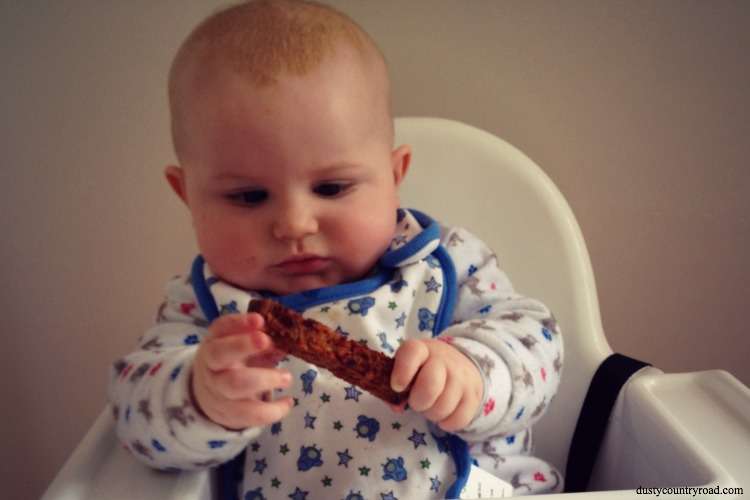
We've hit that point. William baby is 6 months old and looking for things to eat. And wanting to chew on everything in sight. So instead of giving him cardboard [which gets accidentally eaten], I thought it best to give him something to gnaw on that he can actually eat.

I googled and found a few recipes for banana teething rusks, but they all contained added sugar. Which I thought was a bit - not so good. Because apart from natural sugars in fruit, I don't want my little getting too much of a liking for sugary stuff. Anyway the recipes I did find were essentially banana bread, sliced and baked a second time. So I decided to try our usual banana bread recipe, which has no added sugar, and see how it worked out.  

I have to say, so far it's working out pretty good. William is happy enough to gnaw away on them, and they soften up in the process, so he actually gets to eat little bits of it. At some point it gets thrown somewhere dirty, and then it goes into the chook bucket. No waste in this house! It's only moderately messy [compared to say, a banana on it's own] and I can pretend it's biscotti and eat a slice too. Win.

So here's the recipe [and for banana bread, just stop after the first bake, it's good].

Ingredients
About 60g butter, melted
1 egg
2 medium bananas, mashed
1 cup self-raising flour*
1 tsp cinnamon

How to Make
Preheat oven to 180 degrees celsius. Grease or line a loaf tin. 
Mix together the melted butter [allow it to cool slightly first], the egg and the bananas. 
Add the flour and cinnamon, mix until all blended in.
Pour into prepared tin and bake for about 40 minutes.
~for banana bread only, stop here and eat it~
Reduce the oven temperature to 150 degrees celsius. You may need to leave the door open for a few minutes for the temperature to drop.
Cut the loaf into slices and place on a lined baking tray. If the slices are too wide, cut them in half lengthwise.
Return to the oven and bake for 45-60 minutes. Keep an eye on them past the 45 minute mark. There is a fine line between hard baked and black and crispy. You want hard baked.
Cool and enjoy. 

These are fine stored in an airtight container for about 3 days. I'm sure you can freeze them, but I haven't tried yet. Do keep an eye on your little one while they chew on them. They could bite a piece off, especially if they've got teeth already. 

Do you have any other suggestions for good [vegetarian] baby chew things? I'd love to hear. I'd really, really love to hear!

*We use gluten-free flour.

17 September 2013

What's With Co-Sleeping Anyway?

We co-sleep with our baby. That is, he sleeps in our bed. Now I am aware that there are about a gazillion different opinions out there on how to parent a child, and I'm not in the business of saying our way is the only way. I'll just share what is working for us. We certainly weren't sure if this was the way to go or not and maybe our experience will help other new parents decide what is best for them.

Co-sleeping is to my mind the most natural thing for myself and my baby. Before he was born, we were just normal, run-of-the-mill people setting up our nursery with a bassinet and then a cot. Well, the cot is still waiting to be painted, the mattress is still wrapped in plastic and the bassinet worked for about 5 minutes. And our baby is nearly 6 months old. 

The first few weeks at home, our baby slept in the bassinet next to our bed. There were a lot of grizzles and a lot of settling [by us] involved. And usually, at some point in the early hours of the morning, I would snuggle him in with me, and off he would go to the most peaceful sleep. So it was only ever going to be a matter of time. 

Truth be told, I felt he was too far away from me in the bassinet too. He felt it, I felt it. My instinct told me to tuck him up next to me in bed, but I had researched co-sleeping, and I had fears that I would roll on him in my sleep, or somehow cause SIDS. There is a lot of propaganda getting around in Australia, and government warnings about the dangers of co-sleeping. I should have known better and listened to my instincts sooner.

So with all the cautions in the world, we started co-sleeping through the night with our baby. He only ever sleeps next to me, never my husband. There is a risk of a baby being squashed by anyone other than a breastfeeding mother. I read about studies that showed a breastfeeding mother would instinctively know where her baby was next to her, whereas a bottle-feeding mother would lose that instinct.

I was paranoid that our sheets would be pulled too far up and suffocate him. So I am very cautious about the way I tuck him in, and I never allow the sheets to get too close to him. Doing this, I then felt his shoulders were too exposed, so we always make sure he has a few layers on his arms, and I crocheted up a little shoulder cover for him [which we affectionately call his 'shroud']. And I check and check and check again, that the sheets aren't too close to his face. 

I created a padded side to the bed - spare pillow wedged between the mattress and my bedside table [and held in place by the bassinet, so it did come in handy after all]. So that he can't roll himself out of bed. He's not yet rolling anyway, so this system may need tweaking once he's more mobile. But I can assure you the only way he ever moves is closer to me.

And the benefits in all this? Well, for starters, my little one is safely tucked in next to me. The slightest snuffle from him and I'm onto it [and yet I can sleep through loud rain/dogs scratching the door/alarm clocks]. It strikes me that my husband takes on more of the 'protector' role, and will wake readily to any outside disturbance, which allows me the comfort of sleeping through those outside noises but being perfectly attuned to the needs of my baby.

Then there is breastfeeding. I don't get out of bed to feed my baby in the night. And I'm still feeding anywhere between 3-7 times, or thereabouts. I don't count how many feeds he has. If he gets hungry, he has a feed. I can almost do it in my sleep. Almost. I simply cannot comprehend getting up that many times a night to feed my baby. Or not feeding my baby if he's hungry. So my sleep disruption, even on a bad night, is minimal. Suits me.

And then there is waking up next to the little one... watching him slowly come out of his sleep and open his eyes, blink a few times, and smile at me. No crying, or having to call for me during the night. I'm always right there. Of course there is the issue of space, and a lack of alone time for my husband and I. But it's a sacrifice we're prepared to make. It's not forever. I look forward to a natural progression from co-sleeping when the time is right. Maybe at the 12 month mark? I really don't know. It works for us now, and when it has to shift, it will.  

You know, co-sleeping seems to be such an unusual practice in this country/region/place. The fact that we do it is reason number 27 why we know we're offbeat parents. Ok so there isn't really a list but seriously, there could be. We rarely talk about it with anyone, because we know it will get a strange reaction. Recently my husband came home from work and said he'd had a client with a 10 month old baby. And they co-sleep. I was surprised, and a bit heartened. We're not alone, even though it often feels like it.

Written for anyone who wants to hear the positive side of co-sleeping, not just the fear tactics that seem to circulate about the practice. Always use your common sense, do your own research and for goodness sake, no babies sleeping in the same room as a smoker.

2 July 2013

Tired Days

Well, it's hardly surprising, really. I'm tired. Today I finally feel really, really tired. A more interrupted than usual night, which saw me sighing and putting the kettle on at 4am instead of continuing the battle for more sleep. I have only myself to blame. I ate bread last night. We were down to bits and pieces left in the cupboards, my planned grocery shop didn't eventuate [I knew it wouldn't when I squeezed in that 20 minute bike ride]. So we agreed that leftover soup would suffice for dinner, rounded out with some cheese on toast. 
A not-so-tired day.
We are blessed living where we do. It's a solid drive to nearby towns for a supermarket shop, takeaway isn't an option, nor is a quick cafe fix. All good points in my book. But we do have a general store in town for the essentials of life - milk [not soy yet but I really should ask for it], tea, chocolate. And bread. Baked at a bakery in the town I used to live in, so it's not the mass-produced commercial bread. It is yummy bread. There's just one little problem with it - a thing called gluten. 

I make an effort to avoid eating gluten. I actually started avoiding gluten when I was pregnant. At 14-15 weeks, when I was thinking my energy levels would pick up somewhat, I was more exhausted than ever. I went to my TCM doctor, who gave me some great reading about eating during pregnancy, and gluten was one of the things best avoided. I tried it, and low and behold, felt about a million percent better for it. So that's where the avoiding gluten started. And I've just kept it up.

I still eat gluten in small amounts, but bread, pasta, flours - are generally of the gluten-free variety or avoided. And small amounts aren't a problem. So I figured a bit of bread wouldn't be a problem either. Oh but it was. Cue 8 hours past the first bits of bread being eaten, and my darling boy had an upset tummy. It happened once before too, with a yummy bread eaten for lunch, and our baby boy in tears and unconsolable that night. My poor baby, with a sore tummy that we can't do anything about, and all because I ate bread.

So, I am off the bread for good now. I should point out that there was extra gluten added to this bread, not just what was in the wheat flour alone. The mass produced bread is probably easier to eat, sadly. It's a horrible feeling, knowing that my breastmilk is giving my baby a sore tummy. I'm refusing to be a guilty mum though. Best to just learn and move on.

So that's why we were extra tired today.

29 June 2013

Garden Share Collective: Chicken Proofing the Vegie Garden

Recently I was contacted by Lizzie of Strayed From The Table about being involved in the Garden Share Collective, a monthly peek into the vegie gardens of bloggers from all over the place. Which I thought was great, and I'm delighted to be taking part. Here is my first post sharing my vegie garden - very much in need of some TLC right now!

It's winter, and despite all the best intentions of planting peas, broad beans, spinach and various other bits and pieces, I've planted... nothing. Now before the judgements commence, let me just say - 3 month old baby. The last time I did any real work in the garden was about 48 hours before he was born. So I have a reasonable excuse. The other problem I've experienced should be fairly self explanatory from the following images.

Those chickens. I blame George [the 'hen' we had named Georgette who matured into a rooster named George]. You see we do have a fence around the vegie garden, just chook wire, so it's not very high. And for a while it did keep them out. And I suspect that if we'd only had the girls, they probably wouldn't have gone in there at all. But with George roaming here there and everywhere, of course he hopped over and of course they all followed and now the whole garden is a complete mess. 

So I've been unwilling to spend time planting seeds or seedlings, knowing that it will be a futile effort with our feathered friends scratching about in there. And I've been a bit stumped as to how to keep them out. We could clip their wings, but I'd prefer not too as it renders them unable to get out of the way of predators. So this is my first attempt at solving the problem - jute webbing around the top of the fence. I'm hoping that the chooks don't try to hop on the fence, as it won't be stable enough to hold them. 

Fingers crossed it works. The plan was/is to plant some peas and spinach and see how they go. We do get frosts but I'll cover them with shade cloth overnight. I've never planted a winter vegie garden before, only summer gardens, so it's all very experimental. In any case, we do have a success story to share. The broccoli that got stripped by caterpillars in summer, is now producing lovely little heads, which I've been picking here and there. We left the plants in, more through laziness than anything, and now we're being rewarded with home grown broccoli goodness. Sometime lazy pays off.

Hopefully next month I'll be able to report complete success at keeping the chickens at bay. If you have any other suggestions to try, by all means, please tell me! And for more vegie garden love, head over to the Garden Share Collective and take a look. And here's a photo of my baby, for good measure, because he's gorgeous.
This is how we garden.

23 April 2013

Birth Story Part 3 - Natural Methods

This is the final of my three part birth story series. Here I'm talking about all the natural methods we used in the lead up to and during my labour, to help the process along. See also the previous two posts in this series - Birth Story Part 1 - As It Happened and Birth Story Part 2 - A Natural Childbirth.


Part 3: Natural Methods

It should come as no surprise when I tell you that I'm a big believer in 'natural' methods - modern medicine takes very mechanical view of the body and holds little regard for the interconnections that exist or for the life force itself. My biggest fears during my pregnancy were not anything to to with the natural process of giving birth; rather, they were fears based around what might happen to me in a hospital situation when I was in a weakened and vulnerable state. But because I had these fears, Charles and I spent a lot of time considering what we wanted to achieve in the birth situation, and learning how we could help ourselves obtain that outcome. Part of that was learning what natural means we could employ for different situations that might come up during and in the lead up to the labour and birth. These are some of the things we used and found effective.

Raspberry Leaf Tea
My midwife suggested this to me at my last anti natal appointment at 38 weeks [I never made my 39 week appointment, I had a baby instead!]. So I hopped into the local health shop and got some straight away. Apparently it can be used during the latter half of the third trimester, and according to the label, it helps to 'tone' the uterus. I'm not sure exactly what that does. I drank a few cups some days, it tasted ok and was a nice change. Did it make baby come along when he did? I have no idea. I can't tell whether my uterus was any more toned or not either. I would say it didn't do me any harm.

Moxibustion
This is a method used in Traditional Chinese Medicine (TCM), which we used extensively throughout my pregnancy, mainly around the sacral area to loosen up and release any blockages in that area [kinda important for that whole area to be loose and able to open up during childbirth]. From about 37.5 weeks, we used the moxa on a point on my little toes, which helps baby into a good birthing position, head down. Baby was most inclined to lie transverse across my belly, so we gave him a helping hand to get his head down. After the first time we tried this method, I felt him move the very next day into a lower head position. We did this every couple of days, no rocket science involved, just gut feel. And baby was in a great position for birth.

Acupressure
Also from the TCM school, we used acupressure points with fantastic results. Partly throughout my pregnancy, similar to the moxa, but most significantly as a form of pain management during labour. Charles used points on my backside, with a lot of pressure when contractions were strong, and I have to say, it was amazing. As in, if a contraction came and he wasn't there, I would be shouting for him to get there. On a scale of 1 to 5, for me, I would say these points took the intensity from a 5 out of 5, down to a 4 out of 5. That may not sound like much, but it went from being 'way too intense' to 'I can deal with this'. Another acupressure point Charles tried on me was on the soles of my feet, to help the labour along. At one point I became aware that he had my feet in his hands, and realising what he was up to, promptly told him to stop it [those contractions were hard enough without adding any extra intensity!]. Anyway on both counts, for me, acupressure worked brilliantly.

Clary Sage
This essential oil has a reputation for bringing on contractions/making labour more intense etc. In my experience, this was the case, and it was very effective. Charles first lit the oil burner with clary sage when I was about 3 hours into labour at home, and although I wasn't so much aware of what he was doing at the time, I was very much aware of the instant increase in the intensity of my contractions. Only then did I realise that the clary sage was being used. Again at the hospital, once I was in the bath, Charles lit the oil burner, and after a short time I had to ask him to put it out, such was the increase in intensity. Anyway it definitely got things going again after labour stalled a little bit with the hospital commotions. Don't use it unless you're prepared for the consequences! We also used lavender essential oil to help relax and calm.

Hypnobirthing
I'd heard a bit about hypnobirthing, but hadn't paid much attention, until I was a month or so out from my due date. Then I started googling, read up on it, and ended up buying a couple of hypnobirthing soundtracks. I listened to them most days [actually, I would lie down with the tracks playing, hear the first few minutes, then wake up some time later]. I have to say it worked for me, in terms of putting me in a good, positive head space for being in labour and giving birth. I played one of the tracks on repeat during the first couple of hours of labour [birthing affirmations] and found it wonderfully calming. Hypnobirthing helped me to be aware of what my body was doing, so I could accept it and help, rather than resist it [therefore making labour harder and longer]. And all without having to do anything much other than have a sleep most days!

Birthing Environment
My preference would have been to have a home birth, but for a number of reasons it just wasn't an option. Home is a very 'safe' environment, which is conducive to labour and birthing. Being in an unfamiliar environment, with unfamiliar faces, bright lights, loud noises, medical equipment everywhere and potential for cold were all things we wanted to avoid. We were lucky that the hospital we attended had only two midwives, both of whom were present for my labour, and no-one else entering the room. We double and triple checked that this would be the case during my anti natal appointments. We dimmed the lights in the bathroom and created the most welcoming environment that we could. After all, this was going to be our baby's first taste of the world! We wanted it to be calm, warm, welcoming; not cold, hard or harsh in any way. I still would have preferred to be at home, but I'm satisfied with the environment we had created in the end.

Magnesium
This wonderful element is really effective at relaxing muscles, which is pretty important [read: critical] during labour and childbirth. We used it also throughout my pregnancy, as it totally solved leg cramps and twitches. We bought it in a powdered form from the health shop, and apart from drinking it every night before bed [except for the odd night when I was just too tired to be bothered, and then suffered twitchy leg for my laziness], I drank it throughout the day when I was labouring. Charles was the one who kept up my supply, routinely handing me some to sip on throughout the day. I can only assume it was effective during labour, based on how effective it was during my pregnancy.

So that essentially covers the natural methods we used to help in various ways during my labour and in the lead up to the big day. We had faith that these methods would work for us, but at the same time it's hard to know until it actually happens. If you're thinking of using natural methods for yourself, do your research and make your own decisions about what you think will work. Listed below are links to some of the resources we used and which we found effective. I'm very happy with how these methods worked for us and I'm very happy that I didn't have to resort to medical assistance. Basically, using these methods allowed us to be in control of how the labour and birth unfolded, rather than being at the whim of medical professionals who often see things differently to us.


Hypnobirthing soundtracks

Read Part 1 of my birth story - As It Happened
Read Part 2 of my birth story - A Natural Childbirth?


12 April 2013

Birth Story Part 2 - A Natural Childbirth?

This is the second of my three-part birth story series. This post is about my experience of wanting a natural childbirth for my baby, and how it actually played out on the day, particularly given the preparation and forethought that Charles and I had put into ensuring an intervention-free birth. The first part of my birth story looked at the day just as it happened, which you can read here. The third and final part looks at the natural methods we employed to assist in various ways both in preparation for and during the birth of our baby. 

Part 2: A Natural Childbirth?

One thing that Charles and I had been very certain of during my pregnancy, was that we wanted to have a natural childbirth for our baby. No unnecessary intervention, no use of drugs and procedures 'as a matter of course', just allowing our bodies and our instincts to guide us. We are of the opinion that babies have been successfully born for a very long time, and modern medicine, with all it's bells and whistles, has been around for a very short time - so are these interventions really necessary? You can read more about my thoughts surrounding my desire for a natural childbirth in my post Planning A Natural Childbirth.

What we found was that in Australia, the rates for normal, physiological childbirth are as low as 5% of all births [source]. A normal, physiological childbirth is one that does not involve medical intervention of any kind - just birthing a baby, the way nature intends for us to do. The processes involved, the interrelations between mother and baby bodies and hormones, the intricate ways of the body during childbirth - these could never be replicated by any medical procedure, and for me, any thought that a medical process could be 'better' than allowing nature to take it's course, is sheer arrogance on the part of the medical profession, and utter nonsense. Acknowledging the necessity of medical intervention in a very small number of actual emergency situations [don't be fooled - the terminology used suggests there are more emergencies than there actually are].

We educated ourselves very well. We attended a birthing course, we researched, we looked at different options for places to give birth, and we considered what kind of support we wanted. We established very early on that we did not want an obstetrician present - as the rates of intervention are higher [sometimes significantly] when an obstetrician was in attendance. Thankfully for us, the closest hospital just started up a new midwife led birthing model, and we decided that this was a good option. Not the best, but the best we could get in our location. I commenced antenatal care with one of two midwives involved in the program, Tom, and we made our desire for an intervention free, drug free childbirth very clear. A second midwife joined the program much closer to our due date, Colleen, who we didn't get to spend as much time with, or make our desires fully clear with.

Anyway, fast forward to the day we turn up with me in labour. Within five minutes of being in the birthing suite, I tripped up twice in my efforts for a natural childbirth - and in ways that we had been coached to look out for. Such is the strength of the medical model. Colleen just asked me to hop on the bed, I can't remember what the exact terminology was, but she didn't say 'I'm going to attach a foetal heartrate monitor which will see you strapped to the bed for the next 20 plus minutes and make contractions extremely painful' [and increase the risk of further interventions], it was something more along the lines of 'just hop up on the bed and we'll see how baby's going'. As soon as I realised what was going on, and had a contraction come at the same time, I ripped at the straps until they were off. I remember repeating the words 'baby's fine, everything's fine'. Tom also suggested to Colleen that she just let it go. This was the first thing we said no to.

At the same time as getting me onto the bed, Colleen was waving a form in front of me that I had to sign - 'just sign here, we need you to sign here'. Being not fully with it, I signed the form, thinking it was some sort of hospital admission form, only to realise seconds later that I had just signed a disclaimer saying I agreed to a managed 3rd stage and an episiotomy, and there was more but that's all I managed to glimpse. Wonderful Charles got a pen and put a line through all the clauses, while I was verbally saying, 'no, I don't agree unless it's absolutely necessary'. Again, Tom was the go-between between us and Colleen, basically saying to her to just let it go. This was the second thing we said no to. The worst part about both of these potential intervention scenarios was that we knew to look out for them, and yet it still happened. If you were not prepared to deal with the way the medical system operates, I don't think you would stand much chance of having an intervention-free birth in Australia.

Anyway, for the next couple of hours we were left mostly to our own devices, me in the bath and Charles helping me through contractions. Every now and then either Tom or Colleen would check in with us, or want to listen to baby's heart rate, which was all fine. The only funny thing here, was that for a little while, I was making no noise whatsoever - I was in a space I had learned through the hypnobirthing soundtrack I had been using for the past few weeks, and was really able to breath through those contractions very calmly. The problem was, it appeared to the midwives that my labour was stalling, as there were no sounds coming from me, and this led to a few comments about potentially speeding up the labour if it wasn't progressing. I ended up going back to making noise enough for them to be satisfied that something was in fact happening, just so as there wouldn't be any talk of speeding things up.

The second stage of labour saw the most pressure for interventions. I was coming under pressure to have my waters artificially ruptured, since they hadn't yet broken. I honestly don't know why this even comes up - baby is perfectly capable of being born with the membranes intact, so if the waters don't break, they don't break. Also at this stage I was on the table in a position without any assistance from gravity, and I found the pushing pretty hard going. There was constant pressure from Colleen [a trained surgeon] to make 'just a little cut' [read: episiotomy] to help baby out. Both Charles and I were starting to get annoyed by this stage, and we had to keep on repeating 'no, it's not happening' at every suggestion. I just can't fathom it - my body would be better off tearing, as it would heal better, than if I was cut. Yes, pushing was hard work. Yes, I was ready for it to be over. But not to the extent that I would even contemplate being cut to speed it up.

Even once baby had been born, the pressure didn't end - there was pressure to have the injection of artificial oxytocin to speed up delivery of the placenta [which interferes with the natural oxytocin produced by the mother, and in turn interferes with mother-baby bonding, and breastfeeding], there was pressure to have the baby's cord cut straight away [we chose to cut the cord once the blood in it had all been returned to baby - baby needs this blood!] and there was pressure to whisk baby away to be weighed and measured straight away [when this is the best time for mother-baby bonding to take place - interference here can lead to problems with bonding and breastfeeding]. We were starting to sound like a broken record: 'no', 'no', 'no'. In a perfect situation, we wouldn't have to worry about any of this; we would instead be able to focus on meeting and bonding with our new baby. But the medical model of birthing is far from a perfect situation, and we held our ground well.

Then there is baby. Standard practice is an injection of vitamin K for the baby at birth. Now, babies are not born with any vitamin K in their bodies, and there is none in the first breast milk. Which raises the question - why does baby need a vitamin K injection? Basically, vitamin K helps with blood clotting, so in the instance where baby is damaged following delivery [think use of forceps] and there is internal bleeding, then vitamin K would be essential. But does it therefore need to be administered as standard practice, to every baby born? You decide, but we didn't want this for our baby. So again, we had to say no. We also declined a hepatitis B vaccination, which in Australia is standard at birth. Again, I cannot fathom why - at birth, a child has no immune system of it's own, so we inject it with substances that can be potentially harmful in the name of protection - but at what cost? Seriously, what is the risk of baby being exposed to hepatitis B at this age? The next hepatitis B immunisation is due at 6 weeks, and we are undecided about whether to have this or not.

At the end of the day, I am happy that I had a natural childbirth. There were no drugs in my system, and Tom even commented on how clear William's eye's were, due to my not having had drugs. The natural bonding process was allowed to occur promptly, William started breastfeeding promptly, and the natural flow of hormones that control these processes was able to occur. The one area where I did receive artificial assistance was in dilating from 9cm to 10cm. I don't know/didn't know enough about that situation to really make an informed decision on the day, so I have to be happy with my decision  to accept that assistance. The reason I'm writing this story is to share just how difficult it is, to achieve a natural childbirth when you're operating under the medical model [in a hospital situation]. Intervention is standard practice, and to avoid intervention, you are stepping outside the norm, you will be considered different, or difficult,  and you need to be strong enough to back your own decisions, in the face of 'experts' telling you otherwise.

I would like to finish by noting one other point. The people involved in my birth situation, all did their jobs as they have been trained to do, and to the best of their ability. Obviously we had to say 'no' to Colleen so many times during the day, but I know that she was doing her best to help me in the way that she knows how. So I'm not writing this post to be critical in any way, because I'm not. Honestly, I'm very happy with how our birth happened. I'm just writing it to highlight how difficult it can be, in the face of modern medical birthing practices, to achieve a natural childbirth. But it is worth it. For me the proof is in the calm, happy little baby that we now have. 

Read Part 1 of my birth story - As It Happened
Read Part 3 of my birth story - Natural Methods

9 April 2013

Birth Story Part 1 - As It Happened

I have been thinking about how I want to write this birth story, and the fact is, I have three different stories to tell. So it's being written in three parts. The first part is, plain and simple, how the day unfolded for me. What happened, what I experienced, and how I ended up with my baby in my arms. The second, will look at birthing my baby in terms of a natural childbirth - I was very adamant that I wanted an intervention-free birth for my child, so I'm going to talk about the issues that came up surrounding that aspect specifically. And finally in the third instalment, I want to acknowledge our use of natural methods for birthing outcomes - with some surprising results surrounding what worked for us. I hope you'll enjoy this series and maybe even take something useful away from it. In any case, I need to write this for me. Thanks for reading.

Part 1: As It Happened

I woke up at 3:20am on Monday morning, with discomfort in my belly. I didn't think anything of it, just baby moving and making me a bit uncomfortable, a trip to the bathroom and back to bed. But back in bed only a few minutes, and the same thing happened - uncomfortable belly sensation. Not something I could just lie in bed for, I hopped out of bed and stood, bent over, until it passed. Back into bed. Repeat, only this time I don't get out of bed, just get on hands and knees on the bed and wait for it to be over, and lie down again. And repeat again twice more, once out of bed, once on hands and knees. You would think by this time I might have suspected contractions - and it crossed my mind, but I really didn't think it was.

Anyway, by 3.40am I had given up on staying in bed and hopped up. I took my favourite blanket and some warm clothes and went to my laptop in search of answers. I was trying to work out whether the pains I was feeling were in fact labour pains, or not, or just a false alarm, so I googled 'what do contractions feel like'. I didn't really become any further enlightened, and the pains kept coming, such that I was standing at my desk bent over as I was reading. I flicked through some notes I had made at a birthing course we had attended back at the start of February. Reading these made me suspect that I was actually in labour, but I still wasn't sure. It was probably around 4.30 at this stage. I also made myself something to eat - a few rice cakes with vegemite to keep me going.

The situation continued - basically my contractions were coming pretty standard 5 minutes apart, and lasting for about 1 minute. I played a 20 minute track of hypnobirthing affirmations that I had bought a couple of weeks earlier, a couple of times, which helped me through those early contractions. I found that I was able to breath into them, and relax my body enough, that I could actually feel the muscular sensation of what was happening - the pulling up of my uterus, at this stage quite low down but moving up higher. This calmed me - knowing and feeling what was actually happening in my body, accepting the movement without fighting it, really just getting my head out of the way and letting my body get on with it. I could do this.

Around 5.30 I decided it was time to wake Charles. He hopped up and got straight into action, watching me for a contraction or two, talking with me about how far apart the contractions were coming, bringing me magnesium drinks and at some point setting up an oil burner with some clary sage and lavender. That actually made things a bit more intense for me, the clary sage, and I ended up calling for a bucket as I started to feel nauseous. No sooner was the bucket delivered than I put it to good use, and poor old Charles had the job of emptying it and bring it back for me. This happened a few times. Purging - getting any last 'stuff' out of my body, clearing the way for labour to progress. It really didn't bother me at all. 

All this time I had been stationed in our office/library, but around 8am I went back to our bedroom. All I wanted in the world was to climb back into bed and go to sleep. I just wanted it all to stop, because I was feeling sleepy, and start again some other time. After a sleep. So I went back to this business of lying in bed, then hopping up for a contraction, then crawling back into bed for those few minutes of rest. Complete with a cat snoozing on the bed and everything. I'm glad we had seen a few dvd's of births in the birthing workshop we attended because I knew that Charles was ok with seeing a woman in labour - as in, he wasn't freaking out. And the cat didn't flinch, she probably didn't even notice.

Sometime next, I decided that I wanted to be in the bath. Or a shower. So we moved to the bathroom, where I sat on a chair in front of the bathroom mirror, being flooded with endorphins between contractions, and standing up holding onto the bathroom vanity for dear life and swaying my way through contractions. They were definitely getting stronger and closer together. During this, Charles was cleaning the bath [as you do] so that it would be nice for me to hop in. I was so very aware, being able to see myself in the mirror, of just how effective those endorphins the body releases are - I could have been fully drugged up, I was so out of it. But at the same time so focused on the task at hand. I'm in awe of what the female body does to assist in childbirth.

Anyway by the time the bath was clean, I knew that I really shouldn't get into it. It was about 10am by this stage, and there was a great big bath at the hospital birthing suite - much more appealing than our poky little bathtub. Around this time Charles spoke to our midwife, and I remember asking Charles to ask if we should go in yet. To which the answer was yes. So I continued to labour in the bathroom, while Charles calmly set about gathering all our bits and pieces together [I had half-heartedly packed a bag some time earlier] and preparing to go. Packing the car, remembering to take baby clothes, feeding the animals. And off we went - me on the back seat of the car, on hands and knees, for the faster than usual trip into town. Thankfully it is one long straight road into town.

At the hospital, I remember trying to walk really quickly down the hallway to the birthing suite, not wanting to have a contraction in the hallway. I almost made it, but then it came, so I had to stop and hang on to the wall til it passed. There were people standing nearby too. Oh well. Anyway we made it into the birthing suite, and I promptly had a contraction and was desperately trying to find something comfortable to hang on to. Then a quick look to see how far I had progressed and we found I was about 6cm dilated at this stage. I would have preferred to be 7cm, but hey, a lot of the hard work had been done. I desperately wanted to be in that bath, so one of the midwives started filling it and Charles set up our station in the bathroom. During this time, I was dealing with the other midwife - who was trying to attach a foetal heartrate monitor to me. This was one of my 'not required' items - at first I didn't even realise what she was doing, but as soon as I did, and being on my back as a contraction hit, I had ripped those straps off in seconds.

I hopped in the bath, which was slightly on the too warm side, but which I was happy with. Between the heat of the bath, the issue of the heart rate monitoring and the car ride in, the contractions had slowed off a bit, and I had a few minutes to just lie in the warm water and rest. I was almost sleeping! Bliss. But Charles, seeing the slow down in progress, lit the clary sage to burn again and there we were, straight back into it with renewed intensity. The bath was amazing, and I stayed in there for some hours, Charles and I working through the contractions. By now, he was using some acupressure points on my backside to help keep the contractions under control. At one point, I realised he had my feet and was working on points to help the contractions along - and pretty much said 'don't you dare!'. I also had to get him to blow out the clary sage burner, I couldn't take the increase in intensity that it brought about.

Somewhere around 1.30pm I was starting to get tired I think, and I was keen to see how far I had progressed. My waters still hadn't broken either. A quick look showed that I was 9cm dilated, but was starting to get the urge to push down. I was struggling by that point - I think the knowledge that I still had 1cm to go and feeling the urge to push was all a bit much for me. The midwife had been offering me nitrous oxide and oxygen since we had arrived, and I had to this point adamantly refused [despite telling Charles on the car ride in that I wanted the gas right now!], but my determination wavered. We asked whether the gas would cross the placenta, and the midwife said no. The final straw, and what saw me end up taking the gas, was that the midwife actually helped to dilate the last 1cm - not an altogether comfortable experience, and pretty much my breaking point. I didn't use it for long, but for that hour or so that I had the gas in my hand, it was a brave person would have tried to take it off me.

So then we were pushing down. This was the strangest sensation ever, and not made any easier by the fact that I couldn't see or really get a feel for the baby moving down as I pushed. My waters eventually broke, which was a relief, as that ended the pressure to have them artificially ruptured. I was up on the bed at this stage, half sitting, half lying, and despite knowing that it wasn't the best position for me to be in [there was no assistance from gravity], I felt too tired to move. I was utterly exhausted, and between each surge I was resting, completely spent. This went on, and on, and on. Actually it was about 1.5 hours all up, but I wanted it to be over so badly, and it just kept on going. As it turns out, the baby had a hand up at his face when he appeared, which would have been making life a bit more difficult for me. I cannot complain though - the time taken allowed my body to stretch perfectly, and shortly after 4pm, baby William was born. Not a nick or a tear on my body. And a surprised midwife who had been suggesting an episiotomy for the past hour. I had to be happy with that. 

The most amazing thing in my life had just happened. My baby boy was passed up onto my belly, and Charles had laughed when my first words to him were 'hey little dude'. What are you supposed to say when you first greet your son? He was slippery and pink and absolutely perfect. We were left to bond, as mammals do, skin to skin, and within a short space of time he was looking to breastfeed. I was also pressured to have the injection to speed up delivery of the placenta. It had actually almost come out, then just stopped, so I knew it was just sitting there. The midwife kept suggestion the injection, I repeatedly said 'it's there, if I stand up it will come out'. Eventually I had to push it out, about 40 minutes after the birth. We also waited until the cord had completely stopped pulsing and was empty of blood before clamping. At this point we let the midwives weigh and measure our baby, and then he was back in my arms, where we stayed for about the next 2 hours, bonding and being a family together.  Charles put a pair of socks on my feet, I was so focused on other things, but he looked after me so well, taking care of the little details. He was absolutely amazing and I couldn't have asked for a better birth partner.

And that, in a very short summary, is how baby William came into our world. It was a total surprise, as I was 39 weeks, and had been saying to Charles the previous evening 'I think it's at least another week off'. Still, he was ready, and weighed in at a healthy 3.41kg. We had said frequently throughout the pregnancy that we thought he might come a little early. Not that there is really any such thing as 'early' or 'late', we have such a tendency to put our own timeframes on babies when in reality, they put theirs on us [and birthing is just the start, as I'm now discovering]. I have to say, this was by far and away the most amazing, best ever day of my life. It all feels a bit surreal now, but I want to hang on to the day forever. Those first moments bonding with my new baby, with Charles at my side, made me happier than I could have ever imagined being.

Read Part 2 of my birth story - A Natural Childbirth?
Read Part 3 of my birth story - Natural Methods

21 March 2013

Autumn in the Vegie Garden - Big Clean Up

It's that time. All the summer crops are spent, done. They all need to be cleared out, and the ground dug over, and built up with compost and manure, to make way for autumn/winter plantings. I've been meaning to get out and do this for weeks, but the heat of summer just kept coming, and I stayed inside. Now the season has changed, and it's happening. Here are some snippets of our vegie garden as it stands this autumn. Grateful for the abundance this garden has provided us with over the summer - tomatoes, potatoes, silverbeet, broad beans, rocket, parsley, basil, sage, squash, carrots, beetroot, chilli, red onions, leeks and zucchini. Learned some things about the crops that didn't go so well - beans, broccoli, cauliflower and celery. I've already got lots of ideas for next summer. 


The sage is still going strong, it should survive the winter. Maybe not in its current location, I would like to build a dedicated herb garden somewhere, but I'm yet to make any inroads into that project. I'm loving sage at the moment. It looks so pretty to keep some in a vase of water in the house [and seems to last for ages that way] and is yummy in lots of meals [like this].

The tomatoes are completely done. You can see that we're in the process of adding gravel pathways between the rows of garden beds. We started this just after Christmas, then stalled - first our garden shop ran out of gravel, and on top of that, we had no rain at all, for months, so the ground was like concrete. Not good for building garden borders, we could barely hammer the stakes holding everything in place into the soil. So we've been waiting for rain and gravel. Maybe this weekend! The black area is weed mat that we put down under the gravel.

The overall garden view. It's about to go from looking like a used up, spent summer garden to a fresh, new plot for autumn planting. Complete with finished gravel pathways and garden borders. Oh yes. I keep the vision of what it will be like in 5 years from now in mind as I work too. Sometimes progress feels frustrating slow, but that is the nature of building gardens. It forces me to slow down, in a good way. I also dream of a fully fenced [read: private] yard...

Chickens. At least they're on the correct side of the vegie garden fence. George the rooster hops into the vegie garden most evenings and helps himself to the last of the tomatoes. The girls stay out at least, and I pick the older looking tomatoes and lob them over the fence for them to eat. Little rituals. In the background you can see the chook house and our compost bays. Another project we have is to add an outdoor enclosed area on the left hand side of the chook house. Once the rain comes and the ground is soft enough to dig in [not that I am doing any digging, that is Charles' department!].

I've got a list of things to try growing over the coming winter, including spinach, asian greens, silverbeet, lettuce, turnips, parsnips, shallots, leeks, onions and peas. For years I've been a summer gardener, but I've not yet tried to grow much over the winter months. Usually because I was never in one place long enough to worry about it. So it's very experimental for me. We do get frosts here, so I may need to get into the habit of covering some garden beds overnight to protect the plants. We shall see. It will also depend a lot on how much time I can put in - having no idea what life with a new baby will be like, I don't know how much I will be outside in the garden. Hopefully still enough to grow some crops.

It really is a labour of love, vegie gardening! How's your garden going at the moment?